As students return to classrooms this fall, artificial intelligence is no longer a future consideration for K–12 education. It is already changing how many students search for information, brainstorm ideas, complete assignments, and engage with learning.
For schools, the question is no longer whether students will use AI.
It is how well prepared they are to think while using it.
AI readiness starts with thinking readiness.
Students need more than the ability to use new technology. They need the critical-thinking skills to question what it produces, evaluate the information in front of them, recognize when something doesn’t make sense, and make informed decisions about what to trust and what to do next.
As AI becomes more capable, those skills aren’t becoming less important. They’re becoming essential.
Access to Information is No Longer the Challenge
For generations, education has helped students learn how to find, understand, and use information. Today, AI can generate information and responses in seconds.
Today, students can generate it in seconds.
AI tools can summarize a reading, suggest an argument, explain a difficult concept, brainstorm solutions, and produce a polished response from a simple prompt.
That creates extraordinary opportunities for teaching and learning. But access to an answer is not the same as understanding it.
Students still need to ask:
- Is this information accurate?
- What evidence supports this conclusion?
- Is there another perspective I should consider?
- Does this reasoning actually make sense?
- What information might be missing?
Knowing how to ask those questions is what turns access to information into meaningful learning.
AI Raises the Bar for Critical Thinking
The arrival of AI doesn’t eliminate the need for students to think. In many ways, it asks them to think more deeply.
When information can be generated instantly, students must be able to evaluate its quality. When AI presents a confident answer, students need the habit of questioning whether that confidence is warranted.
When multiple solutions are possible, they need the reasoning skills to compare alternatives and make sound decisions.
And those skills extend far beyond AI.
Critical thinking helps students approach unfamiliar problems, evaluate different perspectives, reason through uncertainty, and apply what they’ve learned in new situations.
These are skills students need in the classroom today and will continue to rely on in college, careers, and life.
Are We Measuring the Skills We're Asking Students to Use?
Schools already collect an enormous amount of information about student learning.
Grades, standardized assessments, classroom assignments, and rubrics all provide valuable insight into academic performance and content mastery.
But as the skills students need continue to evolve, another question becomes increasingly important:
Do we understand how our students think?
Understanding how students analyze information, reason through unfamiliar situations, approach problems creatively, and engage with learning can give educators a different perspective on student readiness.
And if critical thinking is becoming more important in an AI-enabled world, schools need meaningful ways to understand and support its development.
From Thinking Skills to Thinking Readiness
This is where the idea of thinking readiness becomes especially important.
Preparing students for an AI-enabled future isn’t simply about teaching them how to use the latest technology. Technology will continue to change.
Students need skills that can travel with them.
They need to know how to reason.
How to evaluate.
How to question.
How to consider alternatives.
How to approach a problem when the answer isn’t immediately obvious.
For educators and district leaders, understanding these skills can help reveal strengths, identify opportunities for growth, and provide another source of information to support curriculum and instruction.
Measuring Critical Thinking Across K–12
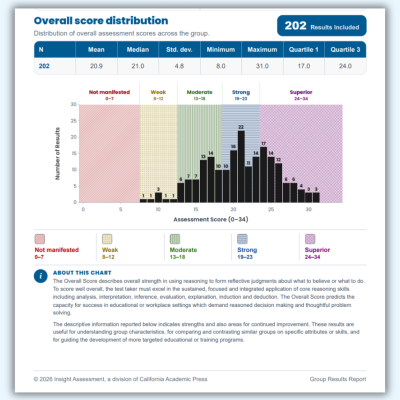
Insight Assessment’s K–12 Reasoning and Imagination Scales for Thinking and Learning (KRISTAL) were designed to help schools understand critical thinking skills and learning mindset from kindergarten through grade 12.
KRISTAL provides developmentally appropriate assessments across four grade bands, giving educators individual and group-level insight into how students reason and approach learning.
Alongside overall measures, KRISTAL examines age-appropriate dimensions of reasoning and learning mindset, providing schools with data that can support curriculum planning, program evaluation, and student development.
The goal isn’t to add another measure simply for the sake of measurement.
It’s to help educators see a part of student learning that traditional academic measures may not fully capture: how students think.
Preparing Students for What's Next
No one knows exactly what AI will look like by the time today’s kindergarteners graduate.
That’s precisely why this conversation matters.
Schools can’t predict every technology students will encounter. But they can help students develop the thinking skills they’ll use to approach new technologies, new information, and new challenges thoughtfully.
As another school year begins, AI gives educators an opportunity to think beyond which tools students will use and consider the skills they’ll need regardless of the tool in front of them.
Because AI readiness isn’t just about knowing how to use AI.
AI readiness starts with thinking readiness.
And helping students become stronger thinkers may be one of the most important ways schools can prepare them for whatever comes next.
Learn More About KRISTAL
Discover how KRISTAL: K–12 Reasoning & Imagination Scales for Thinking and Learning provides schools and districts with insight into students’ critical thinking skills and learning mindset from kindergarten through grade 12.