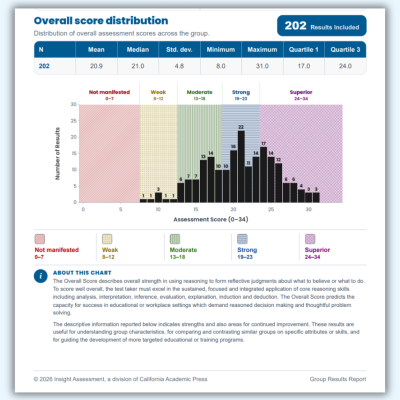
Rubrics have long been a foundational tool in education — offering structure, standardization, and a comparable framework for evaluating student performance. But when educators also aim to assess critical thinking, student mindset, and cognitive skill development, pairing rubrics with research-based assessment tools can provide deeper insight into how students approach learning.
Emerging models of instruction, particularly in digital and blended environments, demand more than structured checklists. They require tools that can reliably measure the dispositions and cognitive skills that shape lifelong learners.
This is where KRISTAL advances critical thinking assessment. Built on decades of validated research, KRISTAL is a research-backed system that delivers consistent, scalable, and nuanced insight into student mindset and critical thinking — helping educators take learning assessment to the next level.
The Limits of Rubrics in Measuring the Thinking Process
Rubrics are well-suited for observable performance. But these benefits come with limitations. Rubrics rely on subjective interpretations and may oversimplify complex cognitive or attitudinal traits.
Rubrics help educators:
- Align grading with learning outcomes
- Ensure consistency across raters
- Communicate expectations clearly
- Deliver feedback at scale
Rubrics may not adequately capture:
- Intellectual risk-taking or perseverance
- Willingness to engage with opposing views
- Depth of reasoning in unfamiliar contexts
- Growth in attitudes toward thinking over time
These are not just fringe attributes — they are core competencies in 21st-century education. And they are difficult, if not impossible, to measure consistently with rubrics alone.
A Research-Backed Alternative: KRISTAL
KRISTAL is Insight Assessment’s validated tool designed specifically to assess thinking mindset and skill in digital, hybrid, and traditional learning environments. Built upon decades of research and psychometric calibration, KRISTAL allows schools and systems to evaluate the internal dispositions that drive learning success.
These include traits such as:
- Open-mindedness
- Intellectual humility
- Cognitive perseverance
- Truth-seeking and reflective thinking
KRISTAL offers a structured, research-aligned framework that replaces guesswork with measurable insight. It is scalable, reliable across diverse contexts, and uniquely suited for K–12 institutions seeking to track mindset development as part of whole-child education.
What the Research Shows
A 2025 peer-reviewed study published in SAGE Open offers a compelling validation of KRISTAL’s underlying framework.
In “Learning Critical Thinking Through Dialogic STEAM Educational Activities,” researchers Fernández-Cárdenas and Santillán-Rosas investigated how discussion-based, STEAM-integrated instruction impacted student thinking dispositions in Mexican high schools.
To measure outcomes, the study used the Educate Insight Thinking Mindset assessment — the legacy tool from Insight Assessment that evolved into KRISTAL.
The results were striking. Students engaged in structured, dialogic STEAM learning environments demonstrated statistically significant improvements in intellectual humility, perseverance, and open-mindedness.
These results support what KRISTAL is designed to do — provide reliable, validated measurement of mindset growth, even in flexible, tech-enhanced, or non-traditional classrooms.
Why This Matters for K–12 and Digital Learning
As districts and educators seek to prepare students for an unpredictable world, measuring content mastery is no longer enough. Growth in dispositions toward thinking — persistence, flexibility, reflection — is what often determines long-term success.
KRISTAL provides the tools to do just that:
- Adaptable to digital or in-person settings
- Backed by peer-reviewed evidence
- Designed for K–12 and postsecondary education
- Aligned with SEL, whole-child, and future-ready frameworks
And because KRISTAL reports are designed to be clear and actionable, educators can use results not only to benchmark learning but to inform instruction and support personalized development.
Conclusion
Rubrics have a role in education, but they are not a comprehensive solution. As learning environments evolve, so must the ways we measure what matters. KRISTAL enables educators to look beyond outputs and focus on what drives them — how students engage with complexity, persevere through challenge, and grow in their capacity to think.
Whether you’re supporting digital learning, whole-child development, or skills-based curriculum, KRISTAL brings clarity, consistency, and research-backed insight into the heart of student learning.