Health professions programs face a complex challenge:
Selecting and preparing students for success on health professions licensure exams- not only in the classroom, but also in clinical training and professional practice.
Most programs rely on indicators such as undergraduate GPA, prerequisite coursework, and content-based entrance exams. These measures provide valuable insight into academic preparation.
However, many programs are now re-evaluating how well these traditional indicators predict student success.
Across conversations with health sciences educators, a consistent theme has emerged:
some commonly used admissions measures are no longer providing the level of predictive insight programs need.
This has led to a more focused question:
What additional data can help identify applicants who are most likely to succeed?
Adding Visibility into How Applicants Reason
Health professions educators have long recognized the importance of clinical reasoning in both education and practice.
The question is not whether reasoning matters.
It is how to measure it in a way that meaningfully supports admissions decisions.
Traditional admissions measures, including GPA and content-based entrance exams, provide insight into what applicants know.
What they often do not capture is how applicants reason through complex, unfamiliar problems.
In practice, this means programs may have strong visibility into academic readiness- but less visibility into how applicants will perform when faced with ambiguity, competing information, and real-world decision-making.
What the Research Shows
Research in health professions education continues to examine how reasoning skills relate to program and licensure outcomes.
A doctoral study conducted by Paul Zeagler, PT, DPT, PhD, at William Carey University analyzed Health Sciences Reasoning Test (HSRT) scores alongside first-time performance on the National Physical Therapy Examination (NPTE).
The findings showed a statistically significant relationship between reasoning scores and licensure success:
- Students with stronger HSRT scores were more likely to pass the NPTE on their first attempt
- A benchmark score (81+) was associated with stronger first-time pass outcomes
These findings align with a broader body of research across health science disciplines, where measures of critical thinking contribute meaningful predictive value beyond traditional academic indicators.
Measuring Reasoning in a Structured, Research-Based Way
One challenge in admissions is that reasoning ability is often assumed rather than directly measured.
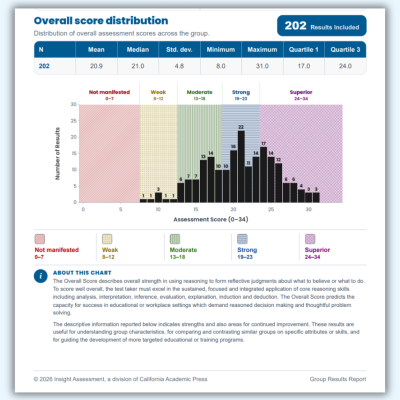
The Health Sciences Reasoning Test provides a standardized way to assess the cognitive skills that support clinical judgment.
Grounded in the American Philosophical Association Delphi research, critical thinking is defined as purposeful, self-regulatory judgment- a process involving interpretation, analysis, evaluation, and inference.
The HSRT assesses these reasoning processes directly, including:
- analysis
- interpretation
- inference
- evaluation
- deductive and inductive reasoning
- numeracy
Numeracy plays an important role in clinical reasoning, including the ability to interpret dosages, rates, proportions, and changes in patient status.
Importantly, the assessment is designed to measure reasoning independent of domain-specific content knowledge—allowing programs to evaluate how applicants think, not just what they already know.
Why This Matters for Admissions
Admissions decisions are not based on a single metric—and they shouldn’t be.
Academic indicators remain essential.
However, knowledge-based measures alone may not fully capture how students will approach complex decision-making tasks required in health professions education.
Reasoning assessments add a distinct layer of insight:
- how applicants interpret and evaluate information
- how they draw conclusions under uncertainty
- how they approach unfamiliar or complex problems
These are the same cognitive processes required for success on licensure exams and in clinical environments.
A More Complete View of Readiness
Programs that incorporate a measure of reasoning alongside academic indicators gain a more complete view of applicant readiness.
This approach does not replace existing criteria.
It strengthens them.
In environments where traditional metrics are providing less predictive clarity, adding a validated measure of reasoning offers a practical, research-supported way to improve admissions decisions.
Moving Forward
Health professions education has long led the way in recognizing the importance of clinical reasoning.
The next step is ensuring that admissions processes reflect that same priority.
If your program is exploring ways to improve prediction of student success, whether for licensure outcomes, program completion, or clinical performance, measuring reasoning skills can provide meaningful additional insight. Contact us today to get started.